
Reverse mortgages: how do they work and what's the catch?
Reverse mortgages have been available in Canada for years, but they still seem to have a bit of a reputation. Mention one at a family dinner and chances are somebody has heard that "the bank takes your house," that you'll have nothing left for your children, or that a reverse mortgage should only be considered as a last resort.
So, what's actually true?
A reverse mortgage certainly isn't right for everyone. But for some older homeowners, it can provide access to money they've spent decades building up in their home while also improving monthly cash flow without having to sell and move.
The bigger question may be this:
You've spent years building equity in your home. What do you ultimately want that equity to do for you?
How Does a Reverse Mortgage Actually Work?
A reverse mortgage allows eligible homeowners to borrow against a portion of the equity in their home.
Eligible homeowners can potentially access up to approximately 55% of their home's value, although that doesn't mean everyone will qualify for the full amount. How much you can access depends on factors such as your age, the value and location of your home, existing debt secured against the property, and the lender's guidelines. Unlike a traditional mortgage, there are no required regular mortgage payments. Instead, interest is added to the outstanding balance over time. You also remain the owner of your home. You're still responsible for things like property taxes, insurance and maintaining the property, just as you were before.
The money can potentially be used in several different ways, including paying off an existing mortgage or other debt, covering everyday living expenses, making renovations, paying for health or care expenses, purchasing another home, or even helping children or grandchildren financially. Depending on the product, you may also be able to access funds gradually rather than borrowing everything at once.
Eventually, the reverse mortgage has to be repaid, commonly when the home is sold, the last borrower permanently leaves the home, or the last borrower passes away.
So... What's the Catch?
There isn't really a hidden "catch," but there is a trade-off. With a traditional mortgage, you're generally making payments that reduce what you owe over time. With a reverse mortgage, you aren't required to make regular mortgage payments. Interest is added to the mortgage balance and compounds over time.
In simple terms: You're trading some of your future home equity for access to money and improved cash flow today.
Reverse mortgage rates can also be higher than traditional mortgage rates, and there can be appraisal, legal and setup costs involved. That trade-off isn't automatically good or bad. It depends on what you're receiving in return.
If accessing some of your equity allows you to eliminate an existing mortgage payment, comfortably remain in the home you love, renovate it to make aging at home easier, supplement your retirement income, or help your family at a time when they actually need it, the calculation starts to look a little different.
The concern I get a lot is: “Doesn’t the interest snowball quickly and diminish all the equity?” and “Could I potentially owe more than the home is worth?”
Reverse mortgage products in Canada typically include a No Negative Equity Guarantee, meaning you won't owe more than the fair market value of your home when it is sold, provided the terms of the mortgage have been met. In other words, if the mortgage balance were ever to exceed the value of the home, the difference would not become an additional debt for you or your estate.
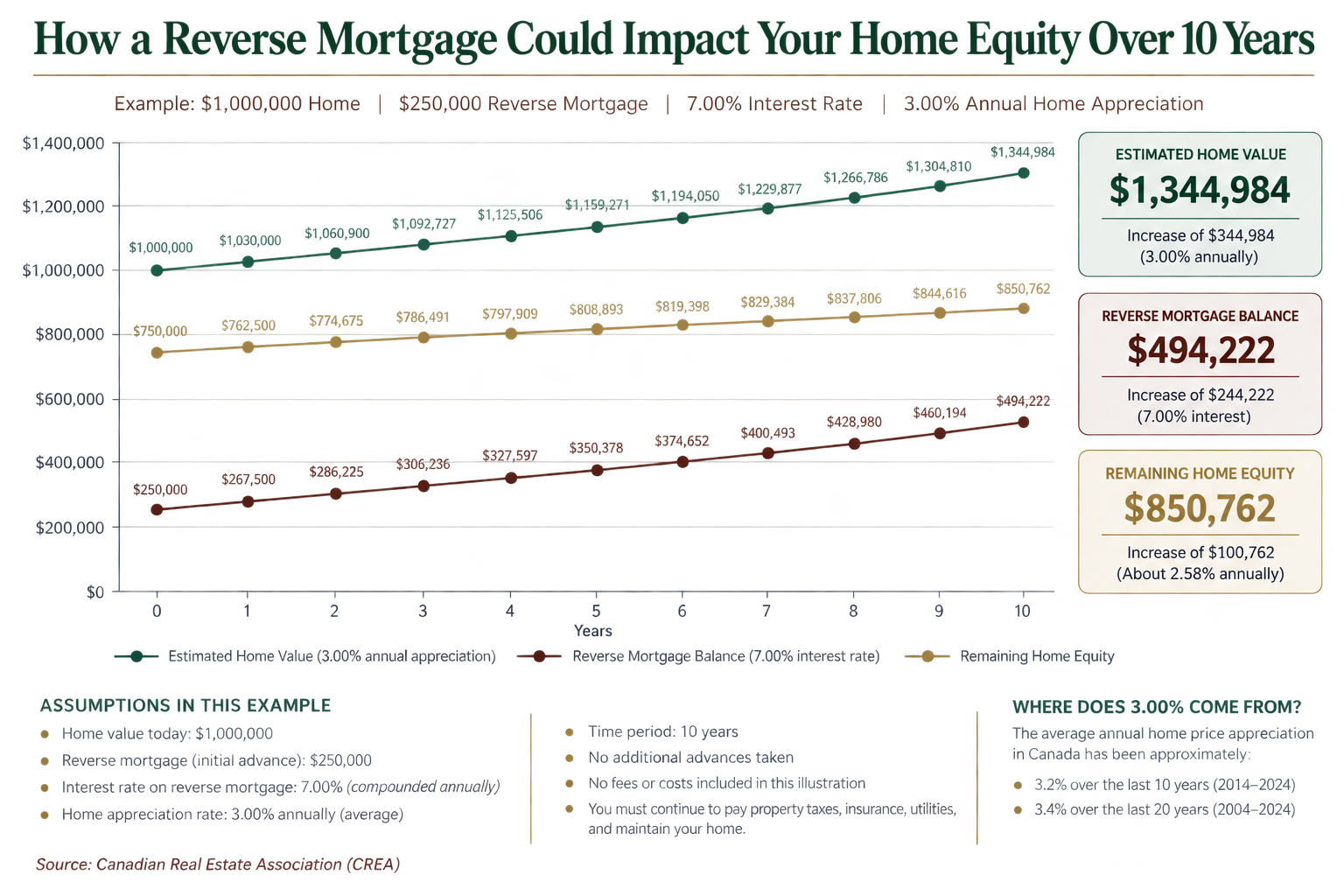
All that being said, you might be surprised how things can look after, say, 10 years of having a reverse mortgage. Depending on how much equity is taken out, the interest, and how your home’s value changes, things can look better than you think. Take a look at the graph below for a basic example.
What Do Lenders Consider When Qualifying You?
This is another area where reverse mortgages are quite different from traditional mortgages.
With a regular mortgage, a major part of qualifying is proving that your income can support the required monthly mortgage payments. Since a reverse mortgage doesn't require regular mortgage payments, qualification works differently.
Some of the major factors lenders may consider include:
Your age: Generally, the older the homeowner, the greater the percentage of the home's value that may be available.
Your home's value and available equity: The lender needs to determine what the property is worth and how much is already owing against it.
The property's location and marketability: Where your home is located can affect both eligibility and the amount available.
Who owns and occupies the property: Age and occupancy requirements can apply to homeowners on title, and the home generally needs to be your principal residence.
Existing mortgages or secured debts: These may need to be paid out using the proceeds of the reverse mortgage.
Your ability to carry the ongoing costs of the home: Even though you aren't making regular mortgage payments, you still need to be able to manage expenses such as property taxes, heating and utilities, home insurance and other applicable property costs.
Reverse mortgages can allow eligible homeowners to access up to approximately 55% of the home's value, but age and the other factors above can substantially affect the amount actually available.
In other words, qualifying isn't simply about asking, "What's your income?" Your age, your property, your existing obligations and the equity you've already built can play a much larger role.
What Do You Want Your Home Equity to Accomplish?
This, to me, is the more interesting conversation.
A reverse mortgage isn't just a question about rates and mortgage balances. It's also a question about retirement, family and what you ultimately want to do with the wealth you've accumulated in your home.
Here are a few questions worth thinking about.
How important is staying in your current home as you get older?
Do you see yourself comfortably aging at home for the foreseeable future?
Or do you think there may come a point when you'd prefer or need the additional support offered by a retirement community, assisted-living arrangement or another housing option?
If you're hoping to remain at home for many years, accessing some of your equity to improve cash flow or make the home more suitable for aging could have real value. On the other hand, if you already expect to sell and move in the relatively near future, the costs and accumulated interest of setting up a reverse mortgage deserve particularly careful consideration.
How important is preserving your home's equity for the next generation?
For some homeowners, leaving as much of the home's value as possible to their children is a major priority. There's certainly nothing wrong with that.
But another family may look at things differently. Maybe your children or grandchildren could benefit from some help today, with a first home, education, childcare or another major expense, rather than receiving a larger inheritance years down the road. It creates an interesting question:
Would you rather leave more later, or potentially help sooner?
There's no universally correct answer.
What would better monthly cash flow actually change for you?
This might be the most important question of all. If you still have a mortgage, what would eliminating that required monthly payment mean for your retirement?
Would additional breathing room allow you to worry less about everyday expenses? Travel more? Spend more time with family? Remain in your home longer?
Sometimes the value isn't simply having access to a large amount of money. It's having more control over your monthly cash flow.
What Can You Use a Reverse Mortgage For?
One of the benefits of accessing home equity is flexibility. Depending on your circumstances, the money could be used to:
pay off an existing mortgage and improve monthly cash flow
consolidate higher-interest debt
supplement retirement income
renovate your home or make accessibility improvements
cover healthcare or care-related expenses
help children or grandchildren financially
fund travel or other retirement goals
purchase another home
The important question isn't simply "How much can I borrow?" It's "What am I trying to accomplish by borrowing it?"
When Might a Reverse Mortgage Not Make Sense?
Reverse mortgages aren't automatically the best choice just because you qualify for one.
If you're planning to sell your home soon, already have sufficient retirement income, can comfortably qualify for and service a lower-cost conventional borrowing option, or preserving as much equity as possible is one of your highest priorities, another solution may make more sense.
There can also be fees and prepayment charges depending on the lender, product and when the mortgage is repaid. That's why it's important to understand the complete terms rather than looking at the interest rate alone. A reverse mortgage is ultimately just one way of accessing the equity you've built.
Learn more about ways to access your home equity.
Final Thoughts
A reverse mortgage isn't inherently good or bad. It's a financial tool that allows you to trade some future home equity for access to that wealth and potentially better cash flow today. Whether that's a worthwhile trade depends on much more than the interest rate.
How long do you plan to remain in your home? What would improved monthly cash flow mean for your retirement? How important is preserving equity for your estate? Could accessing some of that wealth today improve your life or your family's life more than leaving all of it untouched?
Those are the questions that ultimately matter.
The goal shouldn't be to get a reverse mortgage simply because you qualify for one. It should be to understand what you want your home equity to accomplish and then determine the best way to accomplish it.
Common Questions
-
Yes. A reverse mortgage is a loan secured against your home. You remain the owner and are still responsible for meeting the conditions of the mortgage, including obligations such as maintaining the property, paying property taxes and keeping appropriate insurance.
-
No. Reverse mortgages do not require regular mortgage payments. Instead, interest is added to the outstanding mortgage balance over time. Some products also provide options to make voluntary payments or prepayments if you choose.
-
Yes, provided you otherwise qualify and there is enough available equity. Your existing mortgage would typically be paid out from the reverse mortgage proceeds.
-
Eligible homeowners can potentially access up to approximately 55% of their home's value, but the actual amount available depends on factors such as age, property value, location, existing secured debt and the lender's guidelines.
-
The outstanding reverse mortgage balance becomes repayable when the property is sold. After the mortgage and applicable costs are repaid, the remaining equity belongs to you.
-
After the last borrower passes away, the reverse mortgage becomes repayable and the estate is given time to arrange repayment, often through the eventual sale of the property. Exact timelines and conditions vary by lender.
-
There can be. How much remains depends on how much you've borrowed, how long the reverse mortgage is outstanding, the interest accumulated and what happens to the value of your home over that period. This is exactly why understanding the potential long-term impact on your equity should be part of the decision.
-
Yes. Reverse mortgage proceeds can be used to provide financial assistance to family members. Whether doing so makes sense for you is a separate financial and estate-planning decision worth considering carefully.
-
Reverse mortgages include protections commonly referred to as a No Negative Equity Guarantee. Provided the mortgage conditions have been met, the amount owing will not exceed the fair market value of the home when it is sold. This helps protect both the homeowner and their estate if the mortgage balance grows faster than the home's value.
