
Home prices are still creeping down, but mortgage rates are rising: are Ontario home buyers actually better off?
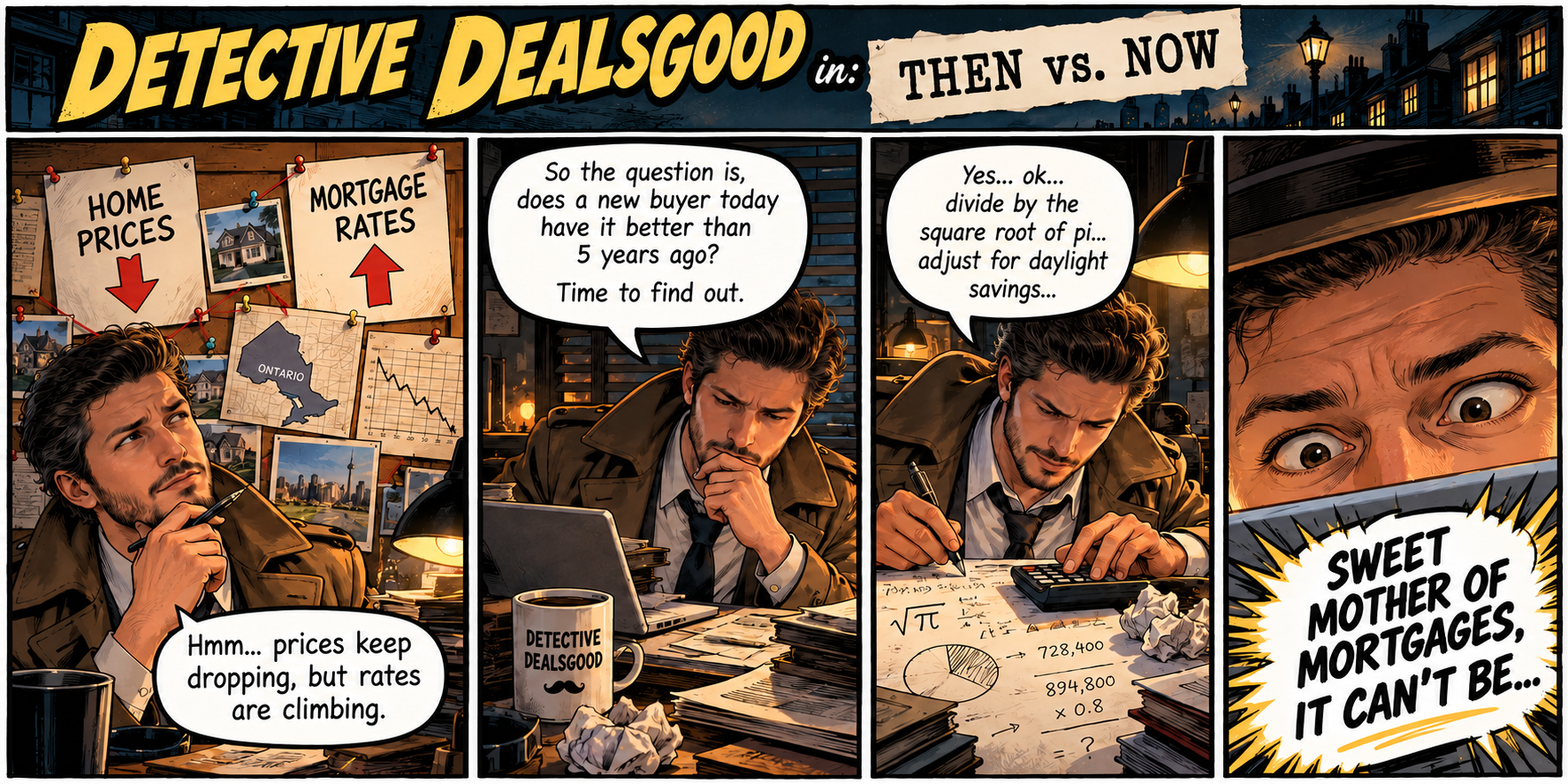
Let's run the numbers.
If you've been watching the housing market over the last few years, you've probably heard two competing arguments:
“Hey, homes are cheaper now” and “Ugh, rates are destroying my dreams of affording a home”
Two things can be true at the same time. So instead of debating it, let's put some real numbers behind it.
In September 2021, the MLS® HPI composite benchmark price for the Greater Toronto Area was $1,082,400. Fast-forward five years. In September 2026, the GTA benchmark was $917,600. That's a difference of $164,800, or about 15%.
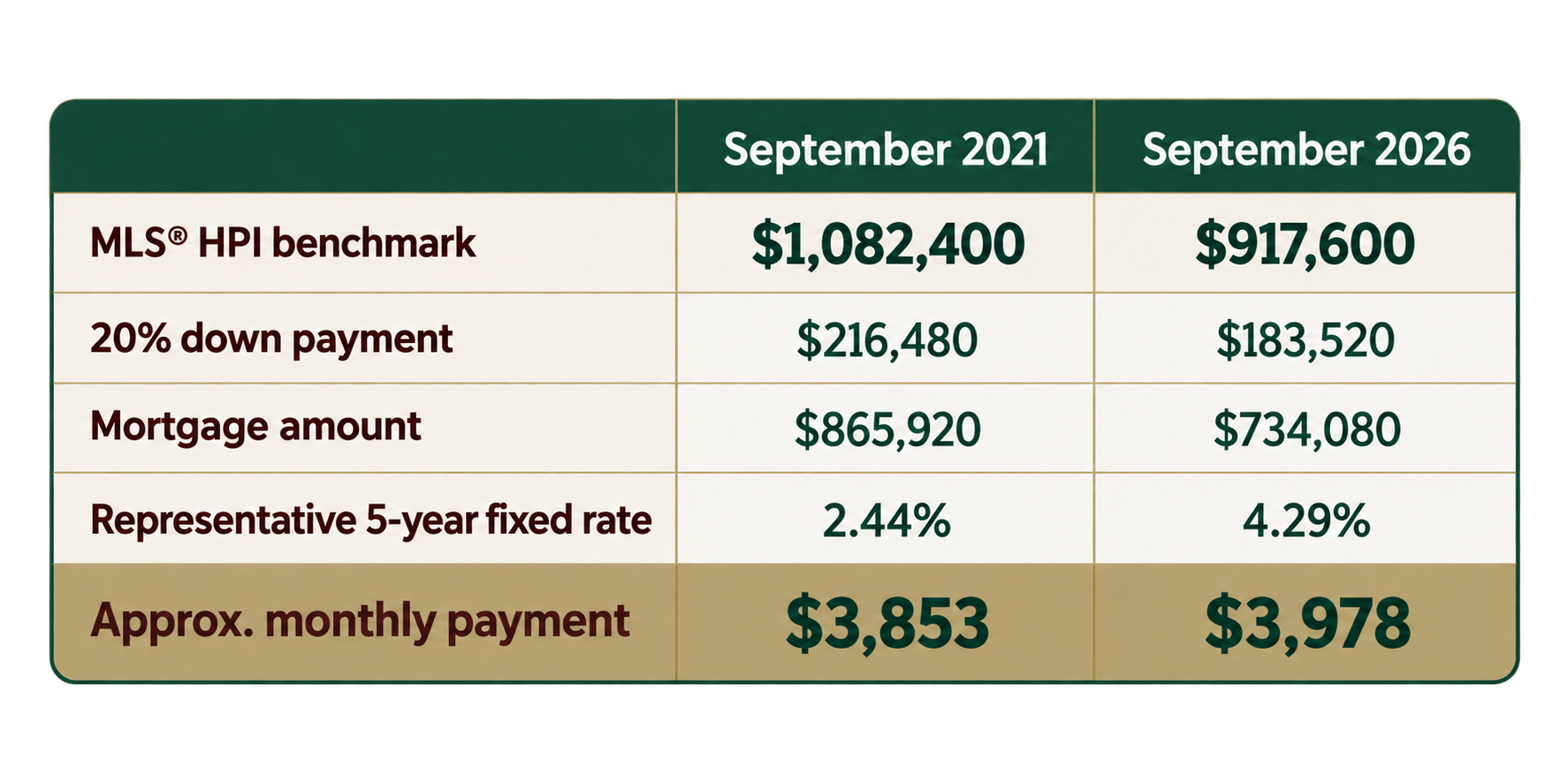
Illustrative comparison using 20% down, a 25-year amortization and Canadian mortgage-interest conventions. Rates vary by lender, borrower and mortgage type.
The catch: mortgage rates aren't remotely where they were five years ago. Competitive 5-year fixed rates in September 2021 were generally sitting in the mid-2% range. For this comparison, we'll use 2.44% as a representative rate from that period. By late September 2026, a competitive conventional 5-year fixed rate was approximately 4.29%. So what happens when we put the two together?
That's the surprising part. Even though the mortgage rate in our example is almost two percentage points higher, the estimated monthly payment is only about $125 more today.
The purchase price matters differently than the rate
Here's the part I think gets overlooked when people compare today's market with the ultra-low-rate years: The price you pay for the house is permanent. Your mortgage rate isn't. That doesn't mean you should buy assuming rates will fall, but hey, in a much more extreme way, that's basically the Boomer mortgage story: MUCH cheaper houses, MUCH higher interest rates. I know, there are a lot of other factors that make that comparison complicated. You know what? Forget I said anything... let's move on.
I'm only making the point that a high mortgage rate doesn't stay attached to a house forever. The purchase price does. Today's payment still needs to comfortably work, but a lower purchase price means starting with less debt regardless of what happens to rates later. In the example above, the 2026 buyer needs about $33,000 less for the down payment and starts with approximately $131,800 less mortgage debt. And while this example assumes a 20% down payment, you don't acctually need 20% down to buy a home.
Today's other advantage: negotiating power
There's also something our mortgage-payment calculation can't measure: What can you actually negotiate on the house?
The GTA market today looks very different from the pandemic-era frenzy. In September 2026, GTA home sales were down 9% year-over-year, while the MLS® HPI composite benchmark was down 4.7% year-over-year. There were 16,500 new listings during the month and more than 26,000 active listings at month-end.
That doesn't mean every seller is desperate to make a deal, but it does mean buyers can look for opportunities. Has the home been sitting on the market? Has the asking price already been reduced? Are there competing offers? Is the seller motivated? Could an offer below asking actually start a conversation?
A better purchase price means a smaller mortgage, less money required upfront and less debt carried forward, regardless of what mortgage rates do next.
So... are buyers actually better off?
Here's where Detective Dealsgood has to put away the magnifying glass and give you the annoying answer: It depends.
It depends.
What would you rather have: more affordable homes or more affordable debt?
Both would be great, obviously. Unfortunately, that's not typically how it goes. Instead of trying to perfectly time both home prices and mortgage rates, I'd start by running the numbers on the homes you're actually considering.
In this article, we've primarily looked at the GTA, which has experienced some of Ontario's more significant declines in home values. But every market is a little different. Once you know where you want to buy, it's fairly easy to run the same comparison using local home prices.
If you're a first-time buyer still wondering whether now is a terrible time to get into the market, I looked at that question more broadly in: Before you give up on buying your first home, read this.
And if you have a property or price range in mind, I can help you compare different purchase prices, down payments and mortgage scenarios to see what actually works for your budget.
Common Questions
-
Neither is automatically better. A lower purchase price reduces how much you need to finance, while a lower mortgage rate reduces the cost of borrowing. Your purchase price, down payment, rate and mortgage amount all work together to determine affordability.
-
While there are indicators that can give us clues about where rates may be heading, accurately predicting interest rates is nearly impossible, no matter how confidently anyone tells you otherwise.
Variable mortgage rates are closely tied to the Bank of Canada’s policy rate, while fixed mortgage rates are influenced more by Government of Canada bond yields. That means fixed rates can move up or down even when the Bank of Canada doesn't change its rate.
Rather than trying to predict the exact bottom, I’d focus on whether the numbers work at the rates available today.
-
Yes. Asking price isn't necessarily selling price. Comparable sales, competing offers, days on market, market conditions and the seller's circumstances can all affect negotiations.
-
Yes. Higher rates increase the payment associated with a given mortgage amount and affect mortgage qualification. Income, debts, down payment, amortization and other factors also matter. Sometimes, getting a mortgage approval depends on how these factors can be managed.
-
They could, but rates are only one factor affecting home prices. Housing supply, employment, income, population growth, consumer confidence and local market conditions all affect demand. Lower borrowing costs can increase purchasing power, but they don't guarantee higher home prices.
About this comparison
This comparison uses the TRREB MLS® Home Price Index Composite Benchmark for the GTA from September 2021 and September 2026.
Mortgage rates are a little less exact. There isn't one rate that every borrower receives, and many historical rate charts track posted rates rather than the discounted rates borrowers could actually obtain. For this comparison, I've used representative competitive 5-year fixed rates available around each period.
The figures are meant to provide a reasonable real-world comparison, not suggest every buyer would have received exactly the same rate. Payments assume 20% down and a 25-year amortization and exclude property taxes, insurance and other ownership costs.
Sources
TRREB — September 2021 Market Watch: GTA MLS® HPI benchmark and market data.
TRREB — September 2026 Market Watch: GTA MLS® HPI and current market data.
LowestRates.ca — Historical 5-Year Fixed Mortgage Rates: September 2021 competitive mortgage-rate data.
WOWA — Canadian Mortgage Rates: September 2026 competitive mortgage-rate data.
